[Case 03]
GoPuck! Fast Hands. Sharp Mind. One Winner..
Tabletop Gaming
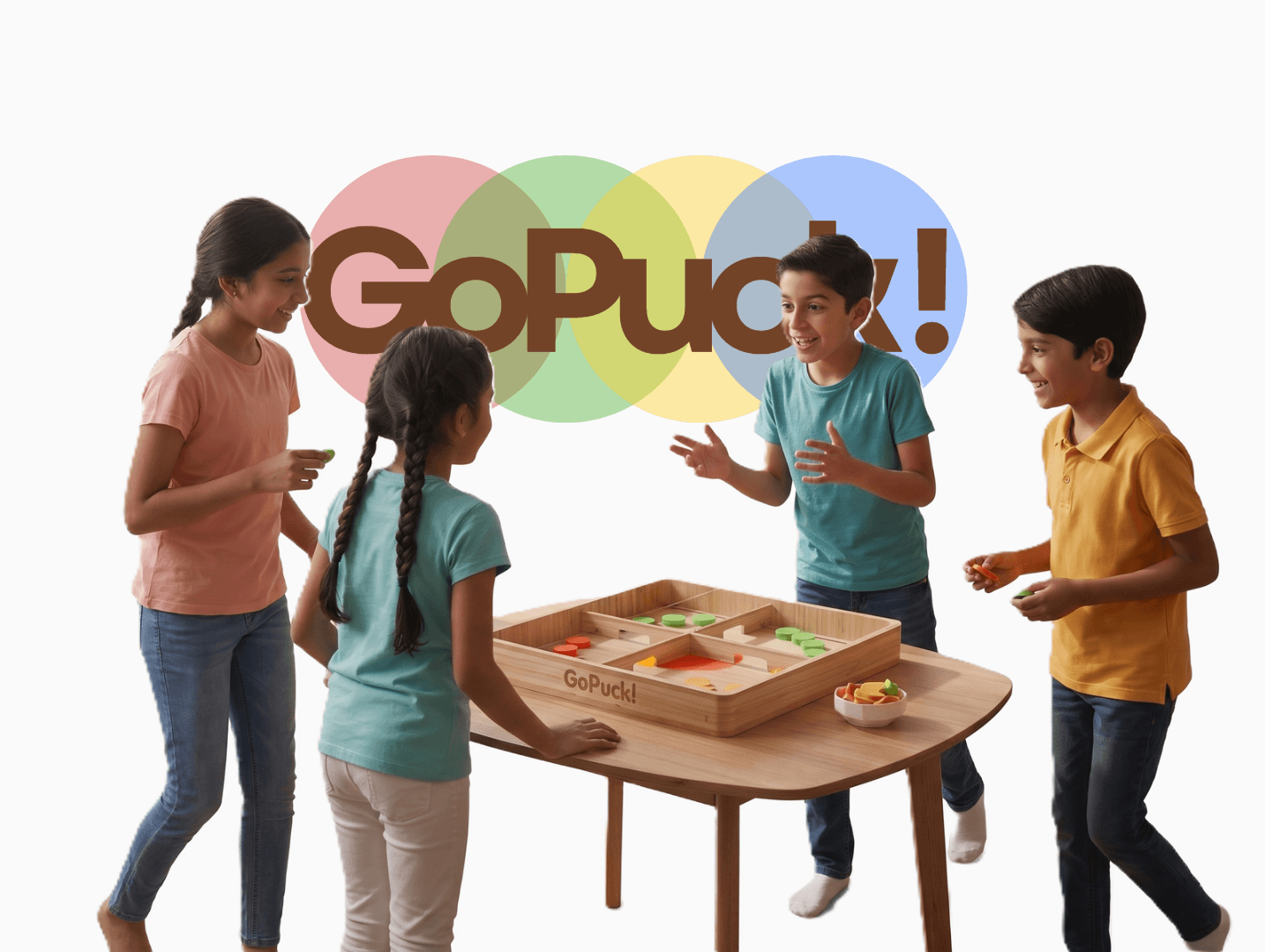
GoPuck! — A Fast-Paced Multiplayer Action Board Game
Designing a high-energy indoor game that combines reflex action, strategy, and competitive multiplayer gameplay for children aged 7 and above.
[Project Overview]
GoPuck! is a fast-paced, action-filled indoor tabletop game designed for 4 players. It was developed to solve a common problem in indoor gaming: turn-based waiting. By combining simultaneous play with a territory takeover mechanic, we created an experience where every second matters and energy levels remain nonstop.
[Problem Statement]
Most indoor games are either too static or involve long periods of waiting for a turn. Our goal was to design a game for children aged 7+ that encourages physical movement and quick thinking. We needed to bridge the gap between simple 'luck' games and slow 'strategy' board games .
[Industry]
Tabletop Gaming
[My Role]
Core Gameplay Lead
[Platforms]
Wooden Board Game
[Timeline]
1 Week
[Process]
[01] Exploration
Sketched out multiple potential product concepts , letting the mind wander free in ideas.
[02] Concept Fusion
We merged the high-speed elastic mechanics of Sling Puck with the strategic circular progression of Ludo . This created a unique loop where players must attack and defend simultaneously.
[03] Physical Prototyping
The project moved from sketches to dimensional drawings and finally into a 54cm × 54cm wooden board. We tested gate sizes and string tension to ensure smooth puck movement .
[04] Social Validation
We debuted the prototype at a college exhibition where it drew nonstop engagement. Players described the experience as 'intense' and 'chaotic fun'.

[Core Mechanics & Systems Design]
01 — Engagement Theory: 100% Active Engagement
In any 4-player turn-based game (like Monopoly or Ludo), each player is actively playing just 25% of the time. The rest is waiting. GoPuck!'s simultaneous model eliminates the dead zone entirely.
Active Engagement Rate = Player Actions ÷ Total Game Actions Per Minute
• For turn-based games with N players: 1/N
• For GoPuck!: Always 1


02 — Game Theory: The Attack-Defend Dilemma
Every second, each player faces a binary micro-decision: attack (shoot pucks forward) or defend (block incoming). This is a multi-player mixed-strategy problem.
No dominant strategy exists — all-attack leads to chaotic fast elimination, while all-defend creates a stalemate. Players naturally find the Nash equilibrium: a dynamic mix of ~60% attack and ~40% defend. The game self-paces without any rule enforcing it.
03 — Systems Design: The 4-Puck Elimination Buffer
The 4-puck elimination threshold isn't arbitrary — it's a structural buffer that creates a recoverable danger window. Too low and the game is punishing; too high and eliminations feel irrelevant.
Tension explicitly peaks the exact moment the 3rd opponent puck enters your quadrant. At 3 pucks, you enter a critical panic window—one more incoming puck means instant elimination. This creates an intense, highly strategic 20–30 second window to defend and recover, aligning perfectly with Csikszentmihalyi's flow state: the optimal balance between high challenge and high skill.


04 — Behavioral Psychology: The Feedback Loop Sweet Spot
The time between cause (shooting a puck) and effect (puck entering a quadrant) is roughly 1–2 seconds. This places GoPuck! in the ideal range for physical games: fast enough for an immediate dopamine reward, yet slow enough to feel skillful and intentional.
Puck physics also introduce variable reinforcement — even with perfect aim, outcomes vary due to mid-board collisions. This unpredictability is exactly what behavioral research identifies as the highest-engagement reinforcement schedule.
[Playable Proof of Concept]
[Outcome]
Nonstop play during the exhibition with players queuing for repeat rounds .
Successfully eliminated 'waiting time', all 4 players remain active at all times.
The wooden prototype survived high-intensity stress testing by players.
[Key Learnings]
Designing for engagement is about rhythm
Fast gameplay loops and constant interaction helped maintain excitement throughout the experience.
Physical interaction changes emotional intensity
Unlike digital games, physical movement and direct interaction created stronger reactions and competitiveness.
Simple mechanics can create complex gameplay
Although the rules are easy to understand in first game , player behavior makes every round feel unpredictable.