[Case 01]
SlotPilot: Beating the Millisecond Clock
Productivity
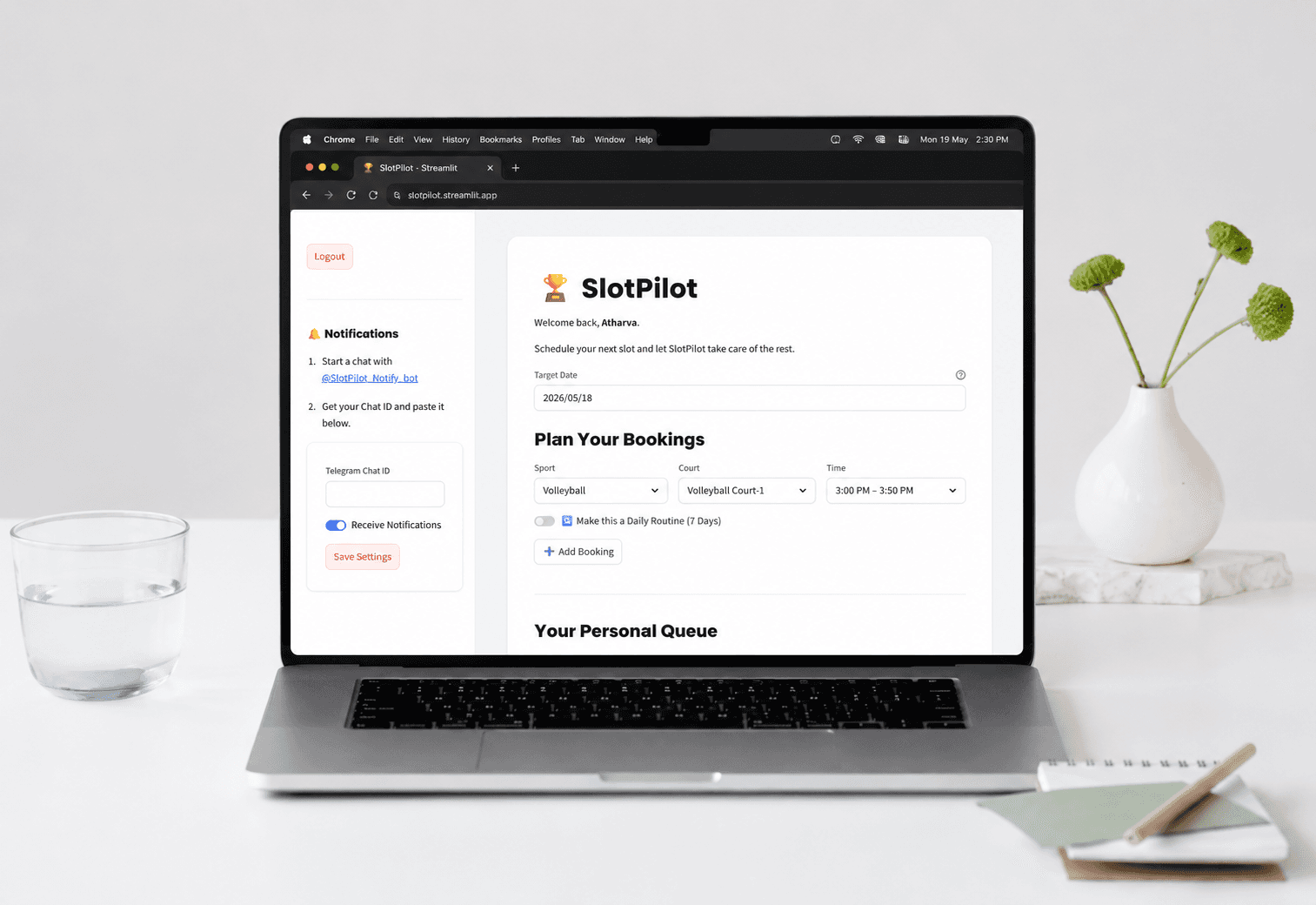
SlotPilot : Automating Competitive Slot Booking
100% Success Rate in High-Competition Bookings
[Project Overview]
SlotPilot was born out of a personal frustration: a college sports booking portal where slots were snatched up in milliseconds. I didn't just want to design a 'better looking' UI; I wanted to solve the underlying friction. I designed and vibe-coded a functional automation system that monitors the portal and secures bookings the moment they go live.
[Problem Statement]
The existing platform required 10 manual clicks. In a high-demand environment, human speed is a failure point. Success wasn't about aesthetics; it was about latency. Every second of manual interaction resulted in a 90% chance of losing the slot.
[Industry]
Productivity
[My Role]
Design Engineer (Design + Vibe-Coding)
[Platforms]
Web (Streamlit) / Python Script
[Timeline]
2 Weeks
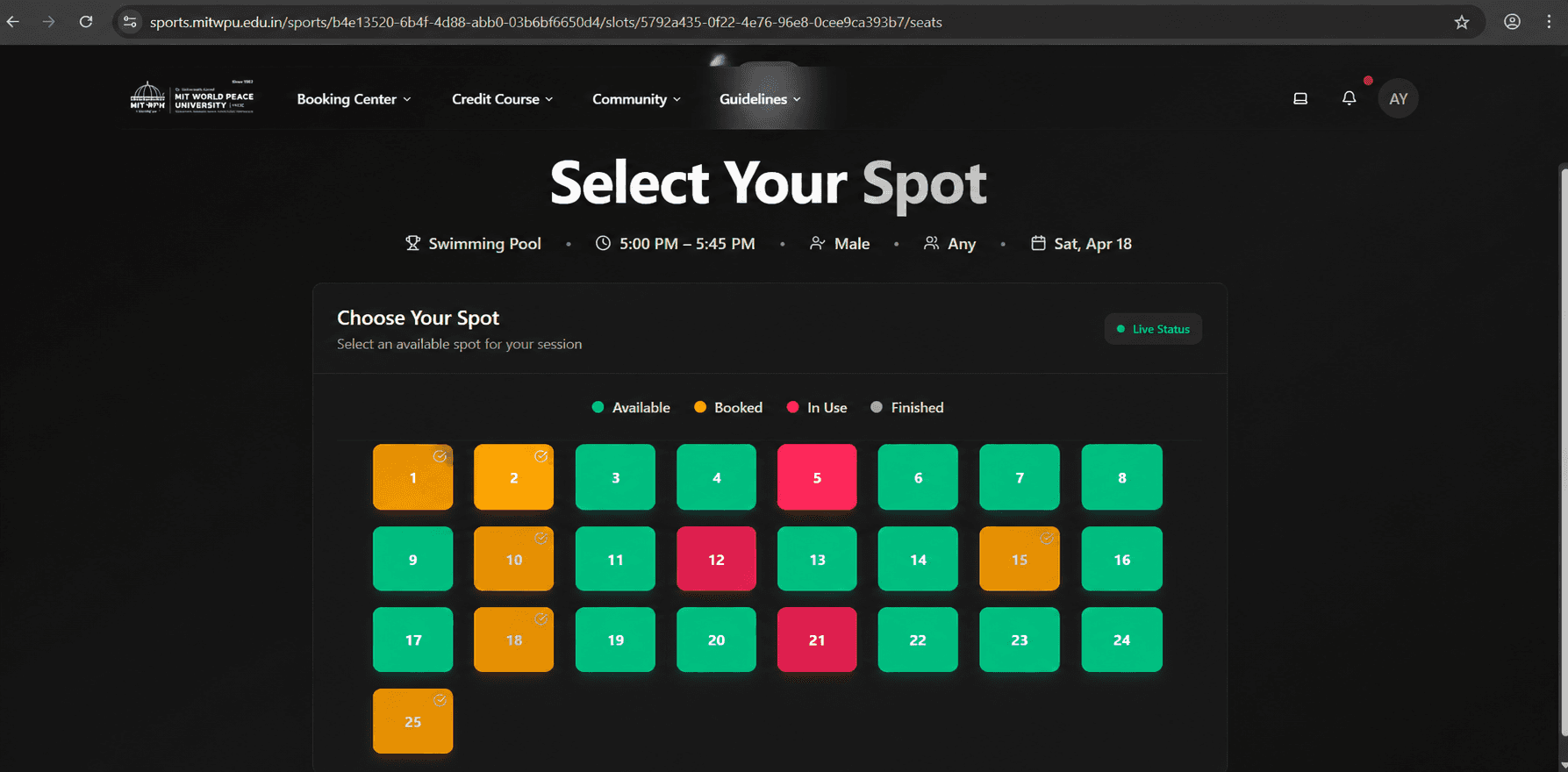
[The Environment- Spots fill up fast]
[System Architecture]
[01] Logic Mapping
I mapped out the API triggers and button-click sequences required to complete a booking. I identified that the bottleneck wasn't the UI, but the timing of the POST request.
Analyzed the portal's DOM structure to identify unique identifiers for court availability.
Documented the sequence of API triggers required to bypass the front-end bottlenecks.
[02] System Insights
Identified that slots were released with millisecond precision, making human reaction time obsolete.
Found that the portal's refresh cycle was predictable, allowing for a "timed-strike" automation approach.
Realized that "success" for this product was zero manual intervention, rather than a "better" UI.
[03] Building the Solution
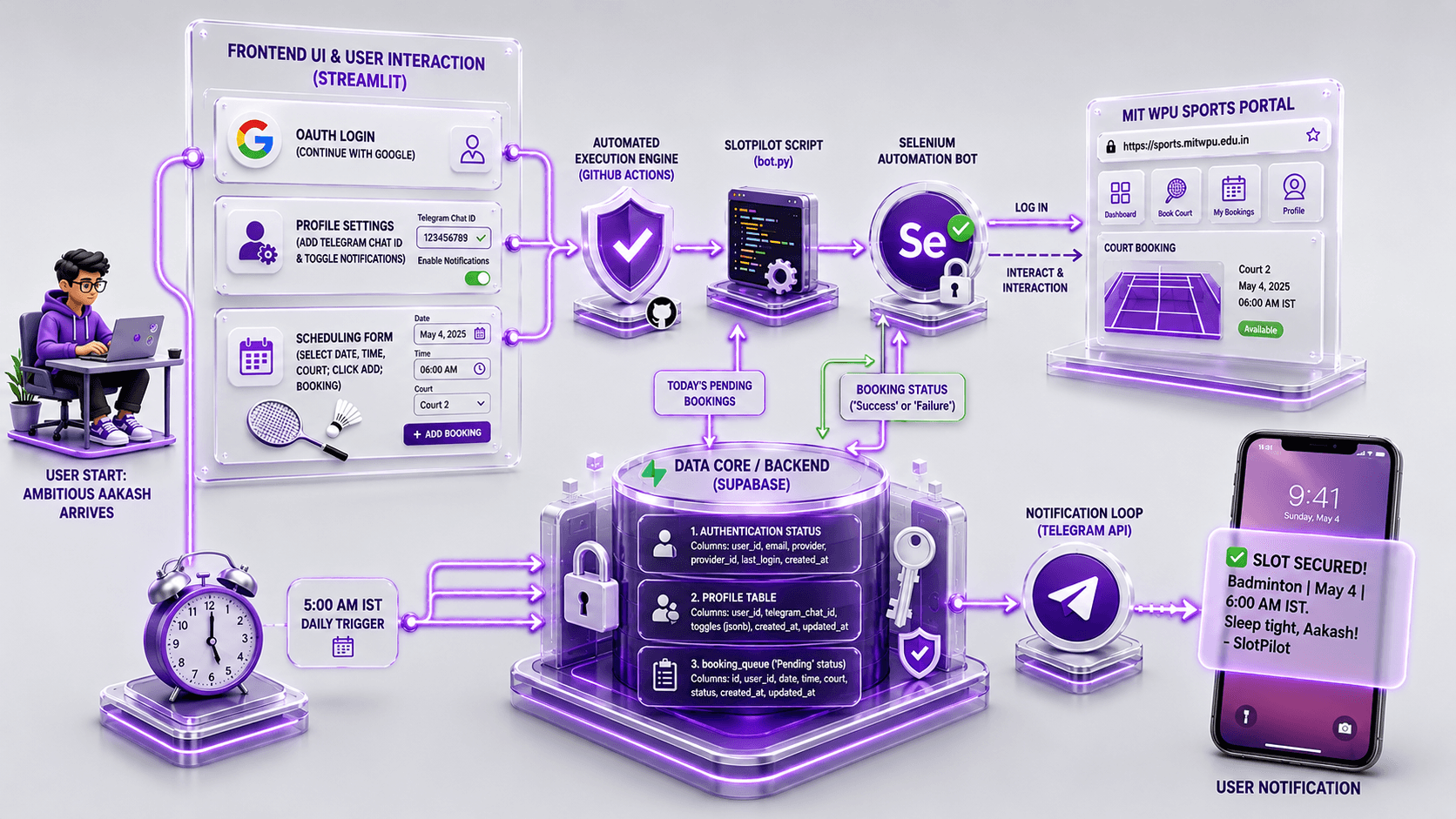
I created a smart tool to handle the booking for the user.
Designed a minimalist Streamlit dashboard to allow for quick preference configuration (Sport,Court,Time).
Utilized session persistence to ensure users only had to log in once per session, cutting down overhead.
[04] Testing & Iteration
Iterated the script timing through "vibe-coding" to find the sweet spot between speed and server limits.
Handled edge cases like "Spot Already Taken" by instantly pivoting to the next available court preference.
Fixed bugs throughout the process to make the tool reliable and as fast as possible.
[System Architecture]
[Outcome]
100% Success Rate in securing booking spots during peak times.
Zero Manual Effort required by the user once their preferences were saved.
83% Reduction in time, taking the process from 30 seconds down to just 5 seconds.
[Key Learnings]
Solve the problem, not just the screen.
I learned that sometimes the best "design" is making a task so easy that the user barely has to look at the screen at all. Success is measured by the goal achieved, not just how pretty the app looks.
AI is a superpower for speed.
By using AI coding tools, I was able to build a working, real-world piece of software in days. It taught me that a designer who knows how to use AI tools can solve much bigger problems than one who only uses Figma.
Finding the real bottleneck is key.
Initially, I thought the portal was just confusing. I realized the real problem was that humans are too slow. This taught me to look deeper at "why" a system is failing before I start designing a solution.